Make Integration Guide
Learn how to integrate PDFBolt with Make to automate PDF generation in your scenarios. Generate professional documents from templates, HTML content, or web pages using Make's visual automation platform.
Prerequisites
Before starting, ensure you have:
- PDFBolt API Key
- Sign up or log in to your PDFBolt account.
- Navigate to the API Credentials section.
- Copy your API key for authentication.
- Make Account
- Active Make account (free or paid plan).
Basic Setup
Configure HTTP Module
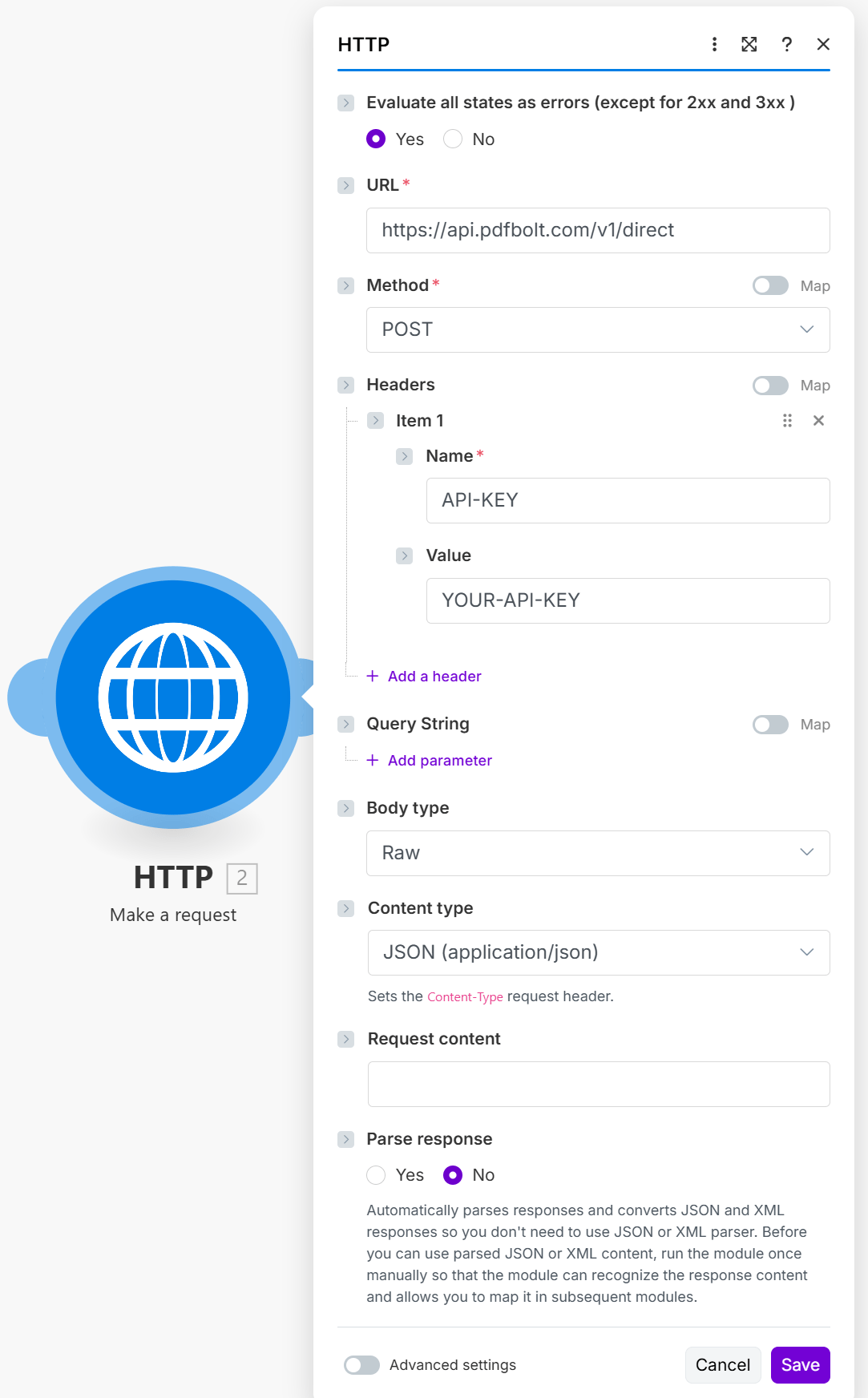
Use Make's HTTP module to call the PDFBolt API:
-
Add an HTTP module to your scenario (select "Make a request").
-
Configure authentication:
- URL:
https://api.pdfbolt.com/v1/direct - Method:
POST - Headers:
- Name:
API-KEY - Value:
XXXXXXXX-XXXX-XXXX-XXXX-XXXXXXXXXXXX
- Name:
- Set up request body:
- Body type:
Raw - Content type:
JSON (application/json)
Choose Your Endpoint
Select the PDFBolt endpoint based on your scenario needs:
| Endpoint | Best For | Returns |
|---|---|---|
/v1/direct | Immediate PDF delivery | Raw PDF data in response |
/v1/sync | URL-based access | JSON with download URL (valid for 24 hours) |
/v1/async | Background processing | Webhook callback with results (paid plans only) |
See API Endpoints for detailed specifications.
Choose Your Source
Select the content source that best fits your use case:
| Source | Best For | When to Use |
|---|---|---|
| Templates | Recurring documents with consistent layouts | Invoices, contracts, certificates – any document you generate repeatedly with different data |
| HTML | Custom documents | When you need full control over a unique layout |
| URL | Existing web pages | Archiving documentation, reports, capturing dashboards, saving public web pages |
Learn more about source parameters in the API Documentation.
Source 1: Templates
Templates provide the most efficient way to generate consistent, branded PDFs by separating design from data.
How It Works
-
Create your template using one of these options:
- Build a custom layout with HTML, CSS, and Handlebars variables in the Dashboard Template Designer.
- Start from a ready-made design in the template gallery.
- Generate a draft with AI from a description or reference file.
- Create and manage the template programmatically through the Template API.
-
Publish the template to make it available via API and get your unique
templateId. -
Send API request with only
templateIdandtemplateData. -
Receive your PDF – PDFBolt returns the generated PDF.
Example: Invoice Generation
Real-world scenario: A customer places an order in your e-commerce system. Automatically generate a professional invoice PDF and send it to the customer.
- Configure the HTTP – PDFBolt module:
When receiving order data from a webhook trigger, configure the Request content field:
{
  "templateId": "your-template-id",
  "templateData": {
    "invoice_number": "{{1.invoice_number}}",
    "issue_date": "{{1.order_date}}",
    "client_name": "{{1.customer_name}}",
    "client_email": "{{1.customer_email}}",
    "line_items": [{{1.line_items}}],
    "total_amount": "{{1.total}}"
  }
}
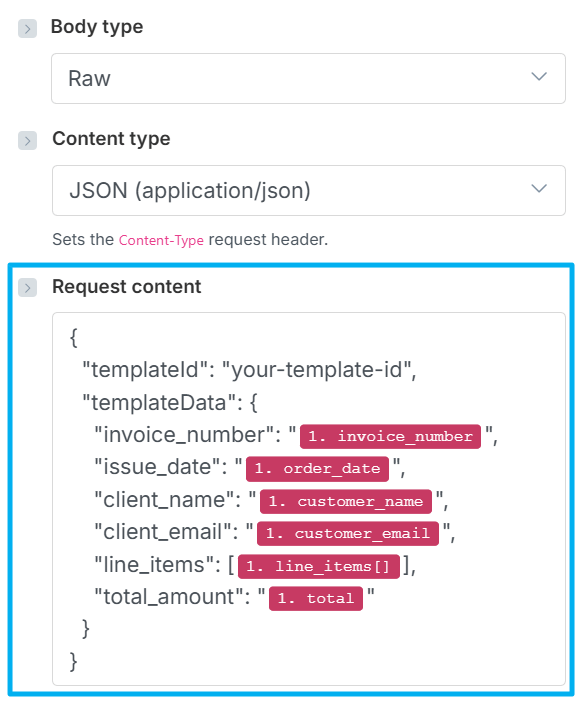
{{1.fieldName}}references data from module 1 (your webhook trigger).- Module numbers auto-increment based on scenario position.
- All field names must match your template's Handlebars variables exactly.
Expected webhook payload example:
{
  "invoice_number": "INV-2025-001",
  "order_date": "2025-01-15",
  "customer_name": "John Doe",
  "customer_email": "john@example.com",
  "line_items": [
    {
      "description": "Website Design",
      "quantity": 1,
      "unit_price": "1200.00",
      "total_amount": "1200.00"
    },
    {
      "description": "Logo Design Package",
      "quantity": 2,
      "unit_price": "250.00",
      "total_amount": "500.00"
    }
  ],
  "total": "1700.00"
}
This same approach works with Shopify, Stripe, WooCommerce, Square, or any other e-commerce platform in Make. Use their respective trigger modules and map the order data to your template fields. The syntax remains the same: {{moduleNumber.fieldName}}.
Template Scenario Example
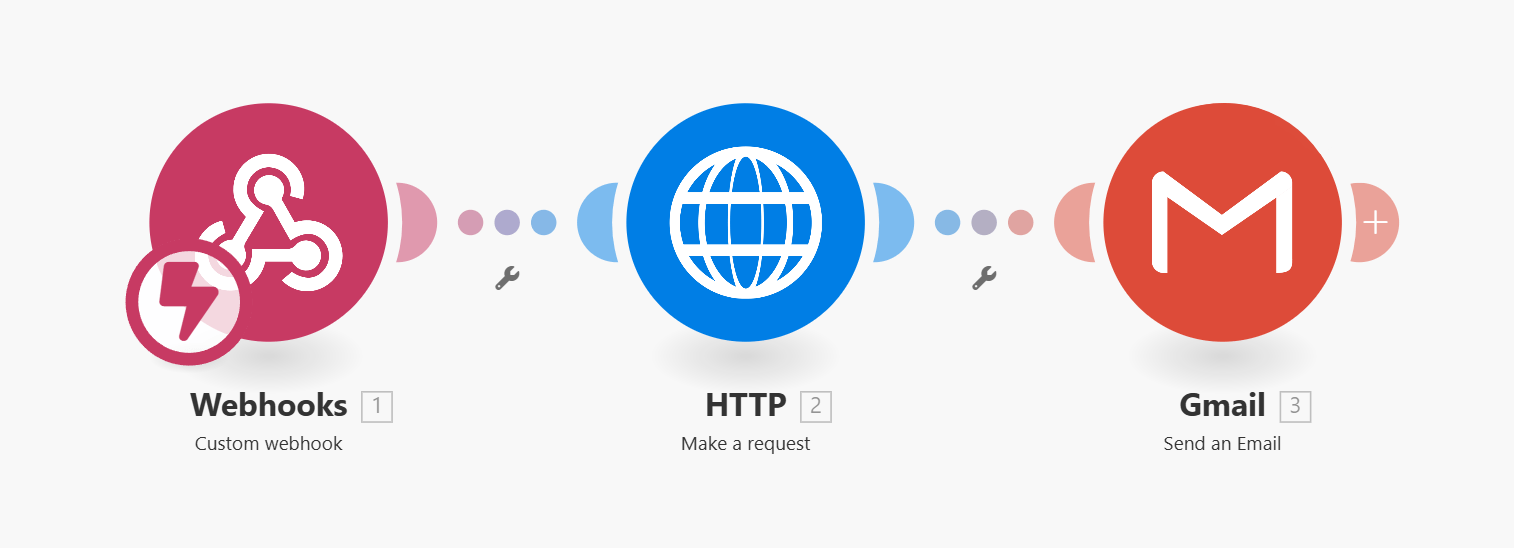
Complete scenario:
- Webhook: Custom webhook – Receives order data from your system.
- HTTP: PDFBolt – Generates invoice PDF.
- Email – Sends PDF to customer.
Source 2: HTML
Convert HTML directly into PDFs within your scenarios – useful for event materials, policy documents, or one-time custom layouts.
How It Works
- Add your HTML content in the scenario.
- Encode HTML to Base64 format.
- Pass encoded HTML to PDFBolt.
- Receive your PDF.
Example: Event Program
Real-world scenario: You're running a conference or webinar and want attendees to download a PDF program containing the full agenda and session information.
- Add a Tools – Set variable module after your trigger:
Configure the module:
- Variable name:
html_content - Variable value: Paste your HTML
View Complete HTML Example
<!DOCTYPE html>
<html>
<head>
    <style>
        * {
            margin: 0;
            padding: 0;
            box-sizing: border-box;
        }
        body {
            font-family: Arial;
            color: #333;
            line-height: 1.7;
            margin: 10px;
        }
        .header {
            background: linear-gradient(135deg, #1e293b 0%, #334155 100%);
            color: white;
            padding: 20px;
            text-align: center;
        }
        h1 {
            font-size: 28px;
        }
        .event-info {
            background: #f8fafc;
            padding: 12px 20px;
            border-radius: 8px;
            margin: 20px 0 10px;
        }
        h2 {
            color: #1e293b;
            margin-bottom: 5px;
        }
        .session {
            border-left: 4px solid #f59e0b;
            padding: 10px 20px;
            margin: 15px 0;
            background: #fff;
            border-radius: 4px;
            box-shadow: 1px 1px 10px rgba(0, 0, 0, 0.1);
            page-break-inside: avoid;
        }
        .time {
            color: #b45309;
            font-weight: bold;
            font-size: 14px;
        }
        .speaker {
            color: #64748b;
            font-style: italic;
            margin-top: 5px;
        }
        .break {
            background: #fef3c7;
            padding: 10px;
            text-align: center;
            margin: 15px 0;
            border-radius: 4px;
        }
        .footer {
            margin-top: 20px;
            padding-top: 10px;
            border-top: 2px solid #e2e8f0;
            text-align: center;
            color: #64748b;
        }
    </style>
</head>
<body>
    <div class="header">
        <h1>Tech Summit 2026</h1>
        <p>Building the Future Together</p>
        <p class="date">September 18, 2026 | Virtual Event</p>
    </div>

    <div class="event-info">
        <strong>Event Details:</strong><br/>
        Date: September 18, 2026<br/>
        Time: 9:00 AM - 5:00 PM EST<br/>
        Platform: Zoom (link will be sent via email)
    </div>

    <h2>Event Schedule</h2>

    <div class="session">
        <div class="time">9:00 AM - 10:30 AM</div>
        <strong>Opening Keynote: The Future of AI</strong>
        <div class="speaker">Speaker: Dr. Sarah Johnson, AI Research Director</div>
        <p>Exploring emerging trends in artificial intelligence and their impact on business.</p>
    </div>

    <div class="session">
        <div class="time">10:45 AM - 12:30 PM</div>
        <strong>Workshop: Building Scalable APIs</strong>
        <div class="speaker">Speaker: Mike Chen, Senior Engineer</div>
        <p>Hands-on session covering best practices for API design and implementation.</p>
    </div>

    <div class="break">Lunch Break (12:30 PM - 1:00 PM)</div>

    <div class="session">
        <div class="time">1:00 PM - 2:45 PM</div>
        <strong>Panel Discussion: Cloud Architecture</strong>
        <div class="speaker">Panelists: Various industry experts</div>
        <p>Interactive discussion about modern cloud infrastructure and DevOps practices.</p>
    </div>

    <div class="session">
        <div class="time">3:00 PM - 5:00 PM</div>
        <strong>Security in Production: Lessons Learned</strong>
        <div class="speaker">Speaker: Anna Torres, Head of Security Engineering</div>
        <p>Real-world case studies on securing applications at scale and incident response.</p>
    </div>

    <div class="footer">
        <p><strong>Questions?</strong> Contact us at events@example.com</p>
    </div>
</body>
</html>
- Configure the HTTP – PDFBolt module with Base64 encoding:
Request content:
{
  "html": "{{base64(2.html_content)}}",
  "format": "A4",
  "printBackground": true,
  "margin": {
    "top": "30px",
    "bottom": "30px",
    "right": "30px",
    "left": "30px"
  }
}
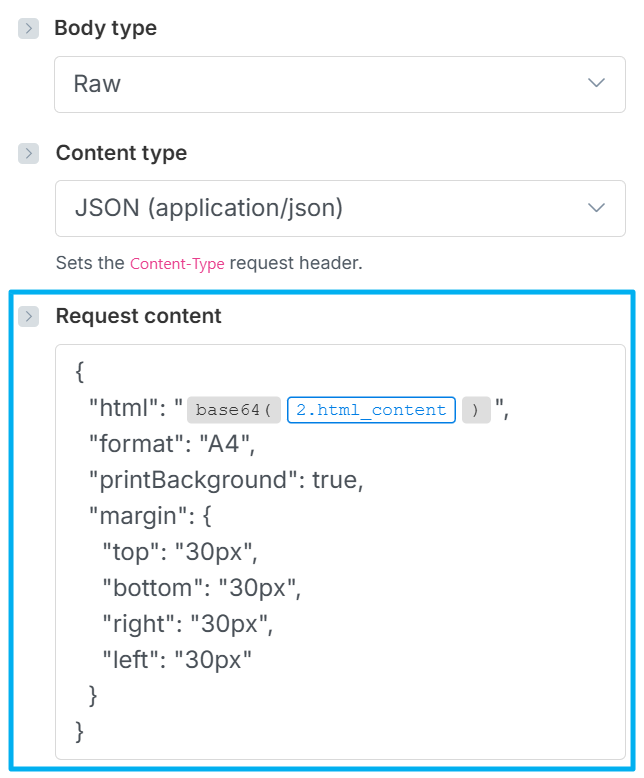
Use Make's built-in base64() function to encode HTML. Wrap your HTML variable with {{base64(your_content)}} in the request content.
HTML Scenario Example
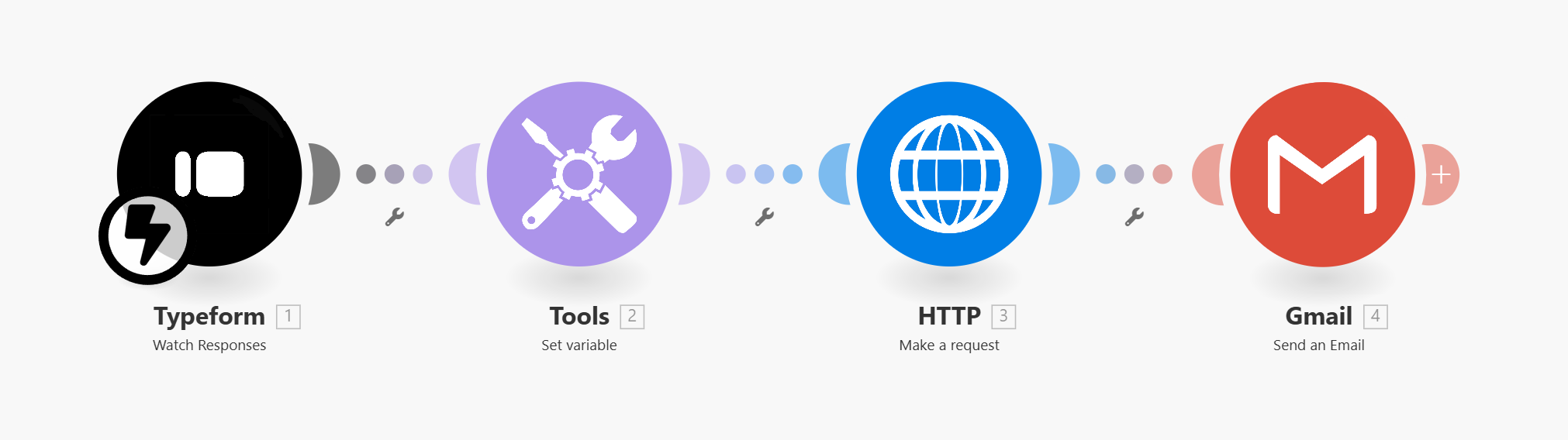
Complete scenario:
- Typeform: Watch Responses – Registration form completed.
- Tools: Set Variable – Store event program HTML layout.
- HTTP: PDFBolt – Convert to PDF (Base64 encoding applied).
- Gmail: Send Email – Deliver program to registered attendee.
Adjust PDF appearance by modifying parameters in the HTTP module Request content. Explore all options in Conversion Parameters.
Source 3: URL
Transform any public HTTPS webpage into a PDF document – useful for preserving online content, dashboards, or generating reports.
How It Works
- Specify the webpage URL.
- PDFBolt fetches and renders the content.
- Delivers a PDF of the page.
Example: Website Change Documentation
Real-world scenario: Your company has public documentation or a status page that you monitor for updates. When your monitoring tool detects changes, automatically capture the updated page as a PDF for compliance records and team notifications.
- Configure the HTTP – PDFBolt module:
Request content:
{
    "url": "{{1.page_url}}",
    "format": "A4",
    "landscape": false,
    "printBackground": true,
    "waitUntil": "networkidle",
    "margin": {
        "top": "20px",
        "right": "20px",
        "bottom": "20px",
        "left": "20px"
    }
}
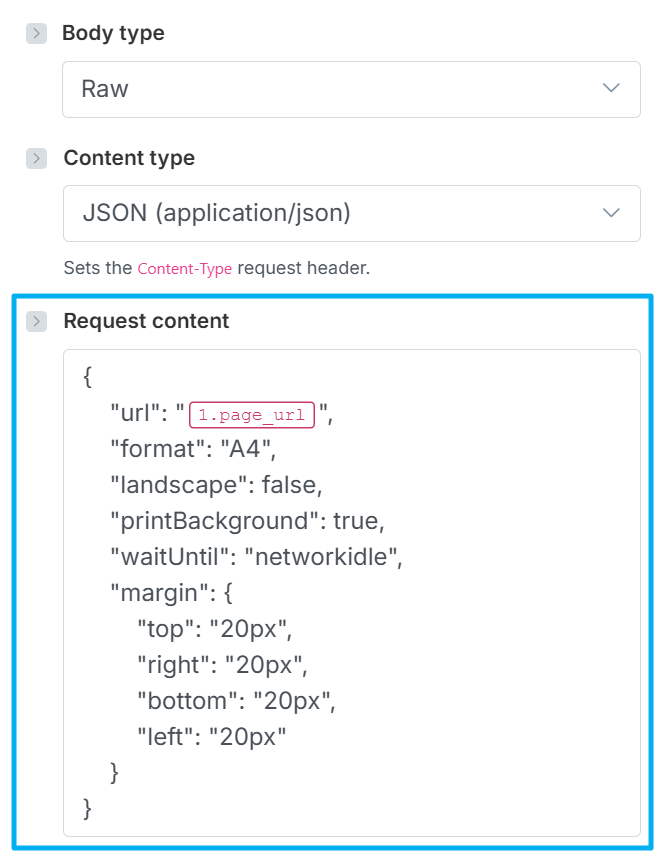
Use {{1.page_url}} to capture the URL sent by your monitoring tool's webhook. This allows you to document any page that triggers an update alert.
waitUntil: "networkidle" waits for all network activity to complete before PDF capture – essential for dynamic content and dashboards.
URL Scenario Example
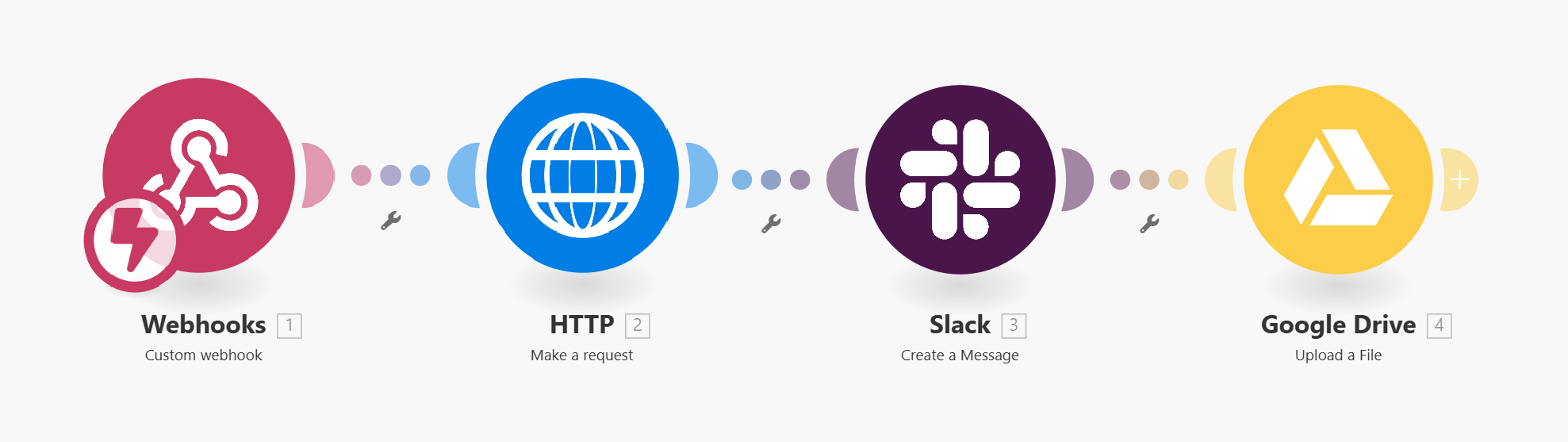
Complete scenario:
- Webhooks: Custom webhook – Triggered when page is updated.
- HTTP: PDFBolt – Convert updated page to PDF.
- Slack: Create a Message – Notify team with PDF attachment.
- Google Drive: Upload a File – Archive snapshot for compliance.
Integration options: Connect this webhook with page monitoring services like Visualping, ChangeTower, or custom scripts that detect website updates.
Additional Resources
PDFBolt Documentation
- Template Management Guide – Detailed creation and management instructions.
- Templates Overview – Template concepts, benefits, and use cases.
- API Endpoints – All available endpoints.
- Conversion Parameters – Complete parameter reference.
- Error Handling – Error codes and solutions.
- S3 Bucket Upload – Store PDFs permanently.